Monday, October 14, 2013

How To Negotiate Your Party Into Extremism, In Three Easy Steps

1) Congressional Republicans threaten to do something extreme in negotiations with Democrats. For example, "We're not going to raise the debt ceiling unless you accept the repeal of Obamacare." It's just a negotiating ploy -- they really think the debt ceiling should be raised, but they're trying to extract concessions by making threats.

2) So that they don't look like hostage-takers, they want to seem like they're making principled demands rather extreme threats. So they argue that the threatened scenarios really fit their principles. For example, "Not raising the debt ceiling is necessary to keep us from going broke."

3) The Republican base believes them. After all, the opposing views are coming from Democrats and the mainstream media, whom they don't trust. So many Republicans think not raising the debt ceiling is necessary to keep America from going broke -- even though it triggers debt default, which actually constitutes going broke!

Do this over and over again, and people in your party start to have views on major issues that weren't even believed by the people who initially expressed them. I don't know whether Ted Yoho is a cruder example of the politicians in (2) or one of the base voters in (3) who managed to win a primary. Probably he's an amalgam of both. 

Sunday, October 6, 2013

Republican Extremism Is Bottom-Up

As Dave Weigel points out, it's not really a few dozen crazy Republicans provoking the government shutdown. It's Republican primary voters all across America. They hate Obamacare and they're willing to defeat anybody who doesn't take a sufficiently hard line against it, just like they've been defeating a long line of electable Republicans in Senate primaries.

Ted Cruz may be the star of the movement, but his role was to bring a particular extreme political option within the scope of Tea Party hopes and dreams so that the Republican base would pressure their legislators to pursue it, not to build a coalition of legislators by himself on Capitol Hill. That's what I'm liking about him -- he strengthened the force that's tearing the Republican Party apart, and it should help Democrats win more legislative races next year, as it did in the last two cycles. One hopes that these forces don't tear apart the country, but assuming that we can pass budgets and debt ceiling increases, the majoritarian structures of democracy provide protection against that.

Friday, October 4, 2013

Friday Obama Caption Contest & Kitsch Cover

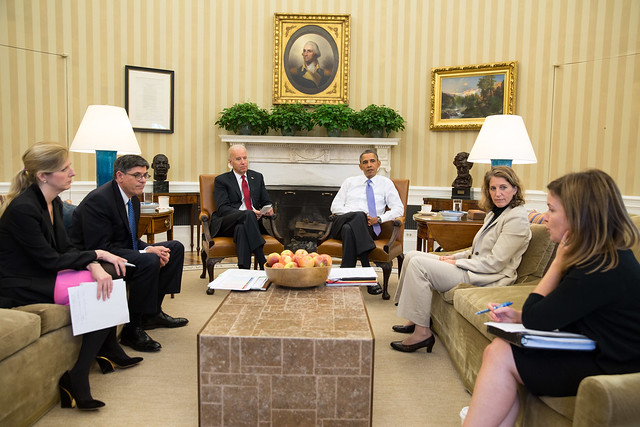
Photography is probably non-essential, so here's the last photo on the Whitehouse Flickr feed. Original caption: "President Barack Obama and Vice President Joe Biden listen as they are updated on the federal government shutdown and the approaching debt ceiling deadline, in the Oval Office, Oct. 1, 2013. From left, Kathryn Ruemmler, Counsel to the President, Treasury Secretary Jack Lew, Sylvia Mathews Burwell, Director of OMB, and Alyssa Mastromonaco, Deputy Chief of Staff"

Today's Kitsch Cover is the Watson Twins performing The Cure's "Just Like Heaven":

Thursday, October 3, 2013

More on the Troglodytes running Southern States, Wisconsin, and parts of the Interior West

21 year-old Chad Henderson is getting lots of calls from reporters. I wanted to highlight this snippet from WaPo's Sarah Kliff:
Henderson is a part-time worker at a day-care center. He did not qualify for tax credits to purchase health coverage because his income is below the poverty line. Since Georgia is not expanding the Medicaid program, that meant Henderson was essentially responsible for his entire premium.
...
Henderson purchased a health insurance plan with a $175 monthly premium. While that price does fit in his budget, he was also hoping for a better deal.
100% of FPL is $957 a month. Chad Henderson earns less than that, and he's going to spend $175 of it on health insurance.

This is the flesh-and-blood consequence of state-level Republican lawmakers—and let us not mince words here, Republicans control at least one of the branches of government in the only states that have not expanded Medicaid— choosing not to expand Medicaid to cover the poorest of the poor. For merely the cost of administering the expansion, states had the opportunity to cover all their citizens earning less than 133% of the Federal Poverty Line. Instead people like Chad Henderson will fork over a hefty chunk of their paycheck every month in insurance premiums.

And Henderson's situation isn't even that bad. A 62-year old retiree—someone who might have lived a life full of physically taxing low-wage jobs—might have retirement benefits that are still below the poverty line. But their premiums would run in the $550-650 range. Remember, for one in five retirees, Social Security is their only form of income. If someone fitting this description lives in the Deep South, Wisconsin, Missouri, Kansas, etc., they will have to send half their paycheck to their health insurance company to get coverage. All because their Governor or State House Speaker or State Senate President didn't want to participate in a nationwide Medicaid expansion.

I don't understand how anyone can call this behavior anything other than immoral.

Tuesday, October 1, 2013

For Obamacare Purposes, Your Income May Be Lower Than Your Salary

As people are beginning to navigate the five-question Obamacare flowchart, it's important to remember that the Affordable Care Act defines "income" as "Modified Adjusted Gross Income". Many line items on form 1040 that people commonly refer to as "deductions" are technically "adjustments to income", meaning that they will not count as income for purposes of determining Medicaid or subsidy eligibility. Most importantly, tax-favored retirement contributions (401k, deductible IRA, SEP, SIMPLE), student loan interest for low-income & middle-class households, and alimony do not count as income for Medicaid/subsidy eligibility. Other pre-tax employer deductions, such as commuter expenses, daycare FSAs, and the like, also don't count as income.

Another important note is that Social Security income, which is non-taxable for many people, does count as income under the ACA.

The Berkley Labor Center put together list of what counts as income under Obamacare, which you might find handy.