Monday, November 5, 2012

Prepare To Ignore the Return of "One Acre, One Vote" Punditry

I'm going to post three maps of the 2008 election. The first is the one we're probably most familiar with; it's similar to the one Brad Delong referenced showing the counties where the McCain drew a higher share of the vote than George W. Bush in 2000. There are very few such counties, concentrated heavily in the Appalachian/Ozark region, McCain's home state of Arizona, or the "Redneck Riviera" north of Tampa.


Don't get too excited about this map, though, because of course lots of counties were going to see an increase in votes for Obama over John Kerry. After all, he won by 7 percentage points while McCain. Instead we should look at whether the county's level of Republican support is growing slower or faster than the electorate as a whole.
This map is somewhat less rosy. Obama's first campaign produced terrific gains in several regions of the country:
  • The Pacific Coast and inland counties in Pacific Coast states, despite not campaigning there at all during the general
  • Heavily Hispanic regions of the Southwest
  • The Upper Midwest, which is to say, the Great Lakes states outside of Ohio and Pennsylvania
  • The Acela corridor (Obama saw "declines" in Massachusetts, probably because Kerry had been the candidate in 2004).
  • A number of counties in the Eastern half of Virginia and North Carolina. Note that these gains extend beyond the former tobacco plantation counties that have fairly large African-American populations.
  • Counties with large African-American populations in the Deep South
  • Almost every major city.
Overall, this map is very good news. If Obama's candidacy marks a permanent shift among some Midwestern voters, it will help Democrats buy time while they push to make Southwestern states more competitive.

But the map we're going to hear a lot about is this one. It's just the raw Obama-McCain map from 2008. As you can see, despite seeing substantial shifts towards Democrats in almost the entire country, much of the land area of the country consists of sparsely populated plots of land that are extremely heavily Republican.


This map is only going to look worse on Wednesday. We're already starting to hear about the lack of a "mandate" unless Obama wins more white dudes. That critique will be amplified by the critique that somehow, because all of Obama's majority is heavily concentrated in a small number of counties, he's somehow not actualy the President of the whole country. This is, of course, bullshit, but when has that ever stopped anyone in politics?

If you resize the counties so that more populous counties look larger, and the reverse for small counties, you get a somewhat fairer picture of the result. Here's one from that guy at the University of Michigan who makes these maps every election cycle:
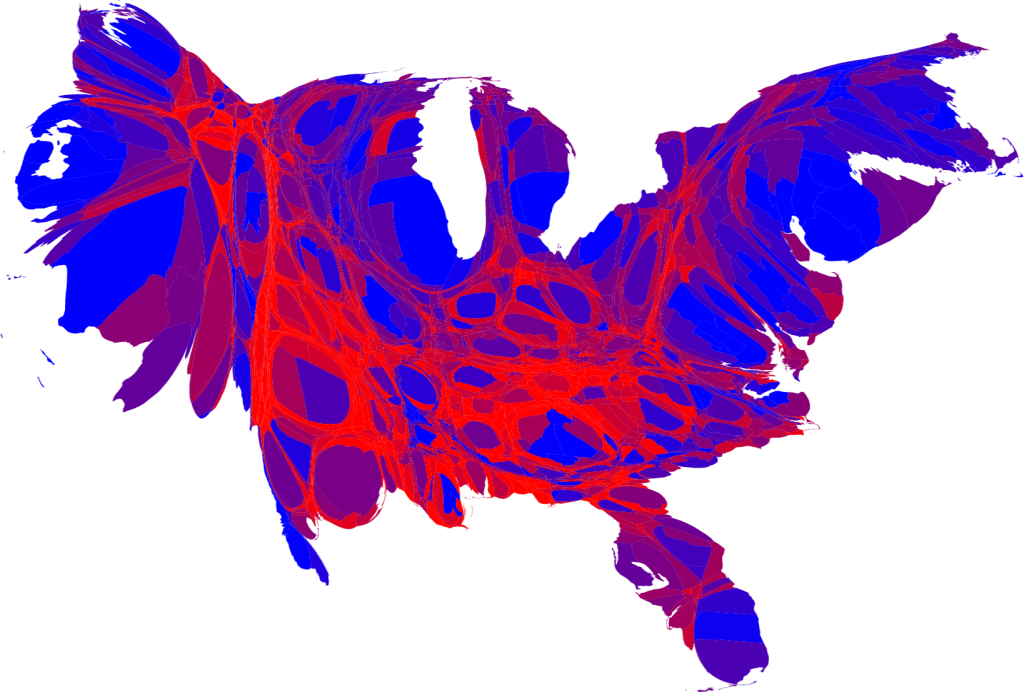
This map makes it clearer that Obama's advantage in places like New York, LA, Seattle, Chicago, Dallas, and Atlanta more than overwhelms the Republican advantage in the Prairie and Mountain West.

Sunday, November 4, 2012

Presidents Are Useful

The picture is from Virginia, where Clinton and Obama appeared at a rally together. I think Tim Kaine was there too. It was Obama's fourth event of the day. I like the happy background ladies.
Getting a bit ahead of ourselves, if Obama wins re-election and has a successful second term, it'll be nice to have two well-regarded Democratic elder statesmen around. They'll be useful for campaigning and generally for articulating Democratic views. The closest thing Republicans have is the Ghost of Ronald Reagan, but GOP primary debates are more his scene than rallies in the closing weeks of a tight general election.

Saturday, November 3, 2012

Advances In Campaign Field Tactics and Electioneering

Saturday afternoon, my wife and I spent a couple of hours knocking on doors for the Washington United for Marriage, the campaign to endorse the legislature's decision to enact gay marriage. As is to be expected at this point in the campaign, field efforts are concentrated on turning out voters who are known to support marriage equality or are very likely to do so, but who are not in the habit of voting consistently even in Presidential elections.

Yes on R74's primary GOTV message is to get these non-habitual voters to visualize and plan the physical act of filling out their ballot and dropping it in the mail box (Washington is 100% vote by mail, though there are dropboxes placed throughout the state). The scripted questions look something like this.
  1. Have you voted yet? (If yes, you're done; otherwise, proceed)
  2. Do you plan on supporting marriage equality? (If no or unsure, at this point in the election you thank them for their time and move on).
  3. Do you have your ballot? (If no, at this point, ask them if you'd like to call the state party HQ for information on how to vote).
  4. Have you picked out a time & place to fill it out? (If they haven't start offering them suggestions ... "during the pre-game show before the football games tomorrow", "after work on Monday", etc., until they come up with something)
  5. Do you think you will mail in your ballot or put it in a drop box? (if mail it in, ask "do you have stamps or have a place where you can pick them up?" -- I swear, I'm not even making this up. If drop off, ask them if they know where the drop box nearest to their home or work is.)
  6. Remind them that the sooner they turn in their ballot, the fewer mailings, phone calls, and knocks on the door they will get.
So this is the new normal. Campaigns that are attempting to reach less-than-consistent voters are emphasizing the small amount of planning that needs to go into the physical act of voting.

When we arrived home, a card from the League of Conservation Voters sat in our mailbox that matched the research. The card included a "voting report card" that graded me as "excellent" since LCV thinks I've voted in the last five general elections. The card also listed the average voting grade for my neighborhood. This message draws from research on the most effective turnout techniques for mailed advertisements, which seems to involve comparing the target's (lackluster) voting propensity to their neighbors. The original experiment actually the listed names of do-gooders and slackers, but advocacy groups have soft-pedaled the guilt trip/shaming aspect of these messages after complaints from a few voters.

In other GOTV news, the Obama campaign has put out some of their GOTV metrics. The campaign claims they've registered twice as many swing state voters as they did in 2008 and made over 125 million in-person voter contacts in swing states (this number counts actual person-to-person interactions, not leaving literature or robocalls). The registration numbers are a little hard to interpret, since we don't know what outside groups may have been involved in registration drives in either campaign. But at the outer margins, the Obama campaign's field edge might be worth up to 2 or 3 percentage points on election day.

In Modern Democracy, Nate Silver Wins

I'm liking the Paul Krugman / Jonathan Bernstein point about how journalists shouldn't be obsessed with scoring secret information from insiders, and how a rigorous method for analyzing publicly available polling data is really what you want in predicting elections.

There are political systems in which you'd want insider information to help you figure out who would rule. If we were ruled by nobles who fought wars, you'd want some military insider to tell you whether Obama's archers were well-supplied with arrows or whether Romney's cavalry was tired.  Or in a more peaceful time, you'd want an insider from the court to tell you who the king was likely to choose for various officers. 

In democracy, the question of who rules is settled by the voting public, not by insiders or anything they have special access to. Polls allow you to simulate elections by asking a representative sample of the voting public. In old times they didn't have as many polls, so you couldn't figure things out with that much accuracy. But now there are like three polls of Ohio every day so you can. If Nate Silver (and Sam Wang, and Drew Linzer, etc.) aren't the kinds of people to turn to for information about who's going to win, you're probably not in a modern democracy. 

Where does this leave pundits who talk to insiders to figure out what's going to happen? Not necessarily in a bad place -- there are plenty of important decision points that aren't in early November, where things look kind of like military strategy (so how will Democrats bargain about the fiscal cliff?) or court intrigue (Veepstakes and nominations). Even in these cases, there's a lot to be said for the public data, but conversations with insiders will be a useful source of information. But when it comes to elections, why would you turn to anybody but the poll-averaging quants?

Thursday, November 1, 2012

Barack Obama's Final Weekend Campaign Travel Schedule

Team Obama has announced their final sprint towards Election Day, which has the President traveling to Florida, Ohio, New Hampshire, Virginia, and Wisconsin.

The logic of stopping in Wisconsin and not Iowa is straightforward: the Obama campaign's early voting infrastructure has banked a much larger lead in the Hawkeye state. Likewise, Obama's early vote lead in Nevada makes his lead there that much more stable.

The six states in question represet Romney's three paths to victory. He can win Ohio, Florida, and then either WI+CO, or VA+any other state. Or he can lose Ohio and win all five remaining states. Here are the current Election Day forecasts from 538 for these states:
  • Wisconsin 88%
  • New Hampshire 75%
  • Ohio 80%
  • Colorado 63%
  • Virginia 61%
  • Florida 41%
Needless to say, team Romney has their work cut out for themselves.